

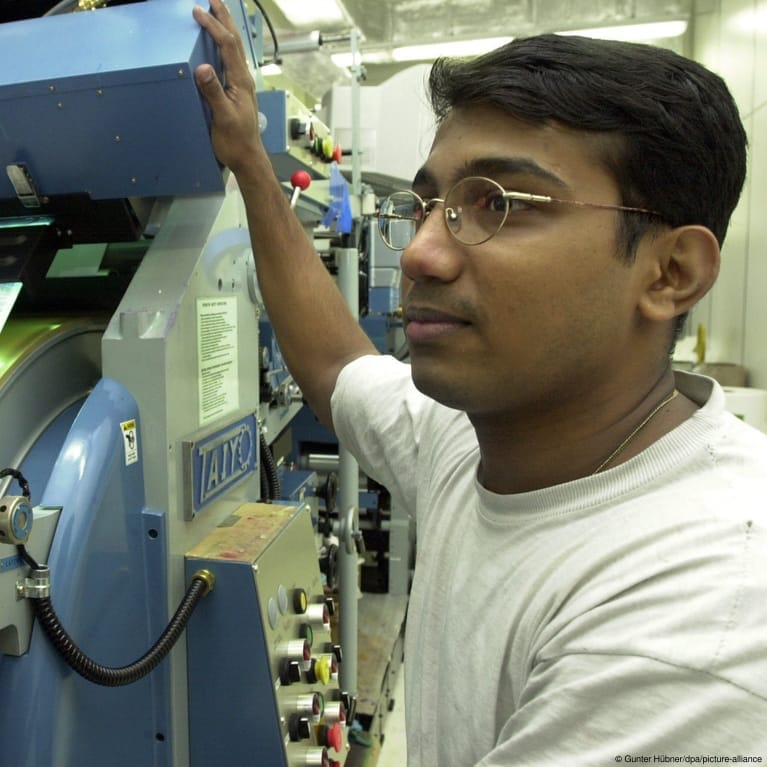
Indian workers are taking jobs in German industries struggling to find staff, but language barriers and risks in recruitment and cross-border employment can complicate their move. A DW report describes routes into work ranging from formal apprenticeships to recruitment through other European Union countries.
One example is Pratyay Saikia, who trained as a butcher at Metzgerei Lederer in southern Germany after arriving from India for an apprenticeship. He told DW that German classes were difficult at first, but his communication improved over the course of the training and helped him settle into the workplace.
German Federal Employment Agency statistics counted 98,000 Indian university graduates in jobs subject to social security contributions in June 2025, up from 89,000 a year earlier. That figure covers graduates, rather than all Indian workers. Germany’s demand also extends beyond IT and health care to occupations including electricians, mechatronics technicians, solar installers and truck drivers.
Language and recruitment risks
Employers, particularly small and medium-sized businesses, can be hesitant to recruit directly from India, said Daniel Raja, who runs a recruitment firm connecting German companies with Indian workers. He told DW that language expectations and concerns among some workplace teams can make hiring harder.
Language can also affect workers’ ability to navigate daily tasks and seek help. David Kipp, a researcher at the German Institute for International and Security Affairs, warned that workers with limited German may have less direct contact with institutions and could be more vulnerable to exploitation.
Some non-EU nationals legally employed in one EU country are temporarily posted to work in another under the Vander Elst mechanism. The European Labour Authority has identified problems in such arrangements, including complicated subcontracting, bogus self-employment and workers’ difficulty accessing information about applicable rules. Posted workers may also depend on an employer for both work and residence permits, ELA spokesperson Pia Fallstrom told DW.
Raja said he had encountered cases of recruitment scams, including one in which a family borrowed money for a promised route to a German job. Kipp called for clearer migration procedures, pre-departure cultural training and stronger efforts to identify trusted recruiters and tackle scams on social media.
 Reid Bentley