

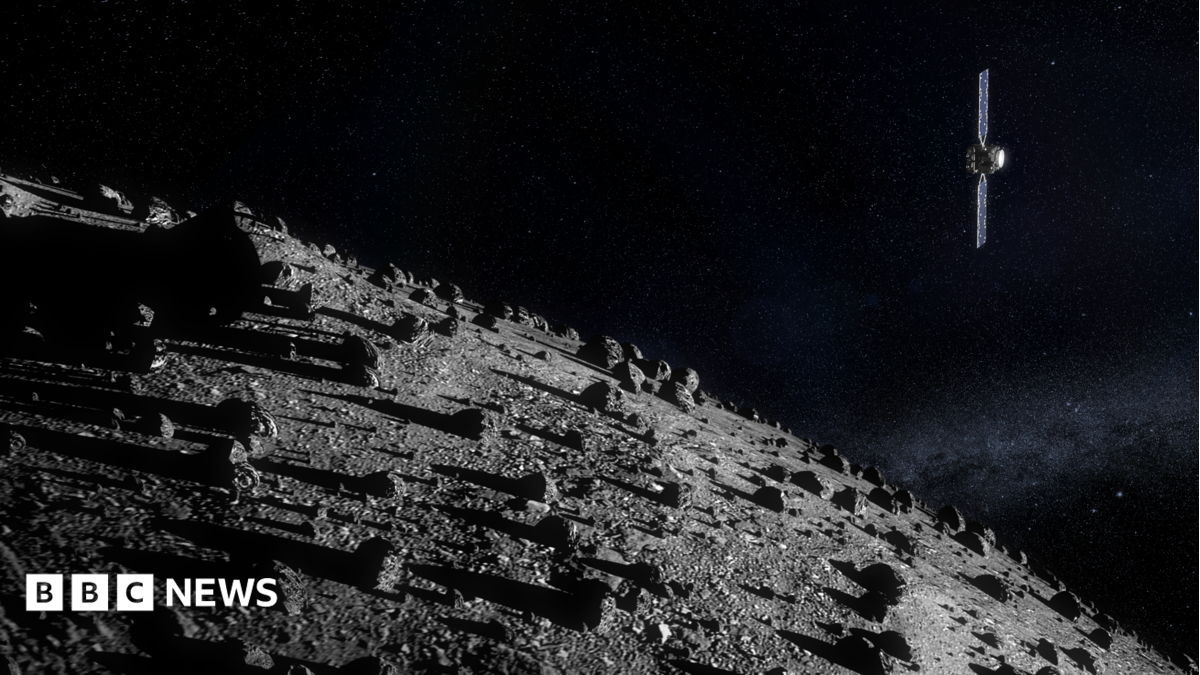
The European Space Agency’s Hera spacecraft has reached the Didymos asteroid system to investigate the effects of NASA’s 2022 collision with Dimorphos. The mission will help scientists assess how the impact changed the smaller asteroid and how effective a similar deflection could be in the future.
ESA said Hera arrived on Nov. 11 and began its initial survey from about 25 to 30 kilometres away. The spacecraft is now characterizing the pair, which consists of the roughly 730-metre-wide Didymos and its 150-metre companion, Dimorphos. ESA reported Hera’s arrival and initial observations.
NASA’s DART spacecraft deliberately struck Dimorphos on Sept. 26, 2022, travelling at about 22,000 kilometres per hour. The collision shortened the asteroid’s orbit around Didymos by about 33 minutes. Telescopes also observed a debris trail extending roughly 10,000 kilometres from the system.
Hera will examine the impact site
DART was destroyed in the collision, leaving researchers without a close-up assessment of the resulting surface. Hera will investigate whether the impact created a crater or substantially reshaped Dimorphos, while measuring its mass and other properties.
The spacecraft carries two small satellites designed to approach the asteroid for closer study, with plans for them to land later in the mission. The observations are intended to help researchers calculate what size and speed of spacecraft might be needed to divert an asteroid, and how far in advance such an effort would have to begin.
The Didymos system is not a threat to Earth; the collision was a planetary-defence test. Scientists say medium-sized asteroids can pose risks, while not all objects in that size range have been located. Hera’s findings will add information about how an asteroid responds to an impact. BBC News reported on the mission’s scientific goals.
 Reid Bentley
 Nicole French